Showing posts with label antitoxins. Show all posts

Friday, April 10, 2015

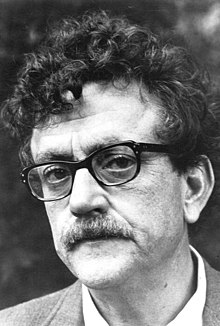
Happy Birthday Kurt

Vonnegut in 1972
"Dear future generations: Please accept our apologies. We were rolling drunk on petroleum.

Plato says that the unexamined life is not worth living. But what if the examined life turns out to be a clunker as well?
-
Laughter and tears are both responses to frustration and exhaustion. I myself prefer to laugh, since there is less cleaning up to do afterward.

Those who believe in telekinetics, raise my hand.

Being a Humanist means trying to behave decently without expectation of rewards or punishment after you are dead.

True terror is to wake up one morning and discover that your high school class is running the country.

It’s perfectly ordinary to be a socialist. It’s perfectly normal to be in favor of fire departments.

Hello, babies. Welcome to Earth. It’s hot in the summer and cold in the winter. It’s round and wet and crowded. At the outside, babies, you’ve got about a hundred years here.


There’s only one rule that I know of, babies---‘... you’ve got to be kind.’
" - Kurt Vonnegut

Sunday, February 2, 2014

An Example Of An Antitoxin - 3

A DDoS attack is being mounted by those infected with the toxins of power (Media Blacks Out New Snowden Interview The Government Doesn’t Want You to See).

The military NSA is trying to stop the American People from viewing the video below.

One antidote to a DDoS attack is to spread the Censor's targeted video around so as to make too many targets for the DDoS attack to persist against.

In order to resist the censorship by the military NSA this blog is utilizing an antidote technique having copied it and now having shared the news.

The military spies who do these attacks use covert and camouflaged Internet locations a la:
If you have a blog and check to see where the traffic to your blog originates, you may notice traffic from websites called Vampirestat.com, Adsensewatchdog.com, Villainstat.com, Uglystat.com [, 2011toxins.org] and/or Zombiestat.com. First off, don't click on them to find out why they are sending you traffic.
(Spam Spoiler, and see this). What they do if you click on them to find out what this traffic to your site is all about, is to interrogate your system to try to detect vulnerabilities.

If they find certain vulnerabilities they will then attempt to place Trojan Horse malware on your computer to be used in a DDoS attack later on when needed (DDoS attack by Spy Agencies, The State Monopoly on DDoS).

The attack on you and others is later mounted when those who would like to use your computer to assist them to suppress the truth about the military mission of spreading imperialism around the world, killing and maiming as they go.

And while spying on millions of innocent people as if they were enemies (Epigovernment: The New Model - 9).

If you want to resist those psychopaths, copy the link or the embed code of the video and become an antitoxin by sharing it.

The previous post in this series is here.

The transcript of the video is available here.


Monday, December 2, 2013

Hypothesis: How Toxins of Power Are Neutralized or Removed

DNA: a molecular machine
Regular readers know that one of the problems with the hypothesis that toxins of power originate at the microscopic level (virus, single celled microbes, etc.) is that some people in power are not overcome by corruption.

Oh yes, the power of their office may stimulate toxins, however, as the hypothetical formulas for toxins of power origination show, those toxins can also be neutralized or overcome by those who are exposed to the toxins while in power, i.e. while in office (e.g. Tables For The Toxins In Power, The Power That Corrupts).

There has been no hypothesis on this Toxins of Power blog, up until now, for how this could happen.

A paper published recently details how pathogens and parasites are converted from dangerous or deadly behavior into mutualistic, symbiotic behavior, which is a complete change of their behavior from toxic bad to helpful good:
Like pretty much all multi-cellular organisms, humans enjoy the benefits of helpful bacteria. (As you may have heard, there are more bacteria in the human body than cells.) These mutualistic microbes live within the body of a larger organism, and, like any good long-term houseguest, help out their hosts, while making a successful life for themselves. It’s a win-win situation for both parties.

Scientists still don’t understand exactly how these relationships began, however. To find out, a team of researchers from the University of California, Riverside, used protein markers to create a detailed phylogenic tree of life for 405 taxa from the Proteobacteria phylum—a diverse group that includes pathogens such as salmonella as well as both mutualistic and free-living species.

Those analyses revealed that mutualism in Proteobacteria independently evolved between 34 to 39 times, the researchers report in the journal Proceedings of the Royal Society B.  The team was a bit surprised to find that this happened so frequently, inferring that evolution apparently views this lifestyle quite favorably.

Their results also show that mutualism most often arises in species that were originally parasites and pathogens.
(Microbial Languages: Rehabilitation of the Unseen -- 2, emphasis in original). This is a discovery which clearly indicates that fundamental changes take place in microbial life, changes which convert them from a "toxic behavior pathogen" into a "helpful behavior symbiont."

I will, in future posts, consider papers that indicate the opposite, that is, the conversion from symbiotic microbes (good guys) into pathogens or parasites (bad guys).

Potential triggering sources for such changes from good to bad has been discussed in Dredd Blog posts Are Microbes The Origin of PTSD? and Weekend Rebel Science Excursion - 16.

Those posts discuss the abrupt changes in all Earth life, including microbes, that happened during the meteorite impact which caused the Fifth Mass Extinction of most Earth life (~90%) some 65 million years ago.

The hypothesis contemplated in today's post should also consider, in bad->good and good->bad behavioral changes, the potential damage to molecular machines within microbes, as well as the repair of damaged molecular machines, as potential reasons for changes in behavior.

In other words, let's consider damaging events as triggers for toxins, but let's also consider repair via healing and remedial behavior as factors for toxin neutralization or removal (see e.g. Putting A Face On Machine Mutation - 4 and the series beginning with The Uncertain Gene).

But, the bottom line is that the genetic material in microbial life, which has been through several mass extinction events on Earth, and perhaps elsewhere, may have recorded reactions within their genes that can be triggered to re-produce bad toxic behavior or good symbiotic behavior, depending on the environmental dynamics being experienced at a given time.

The hypothesis would have to show: 1) how the advent of toxins in an individual who becomes powerful triggers improper genetic ons or offs, and 2) how certain remedial behaviors (think epigenetic behavior) could neutralize or remove that toxic behavior by re-setting the proper genetic ons or offs.

The bottom line is that we are considering both genetic and epigenetic factors in this hypothesis (see e.g. the series The "It's In Your Genes" Myth).

That is all for this post.

The next post in this series is here.

The following video indicates that epigenetic dynamics take place in microbes ... genes do not control them any more or less than genes control us:


Saturday, January 5, 2013

Interlude - 2

In the post Interlude there was an emphasis on the issue of not blaming microbes of every sort for the behavior of a few pathogens that also tend to be parasitic.

There is a world of history that counsels us in this direction, mainly involving the discovery that even microbes with bad behavior at times also have good behavior that helps us.

The exercise, then, is to find out what happened to the good microbes that caused them to become involved in some pathogenic behavior.

There are examples in the history of medicine and science where our culture has caused not only microbes to become pathogens, but culture has sometimes even caused people to become destructive to life.

The example to be used in support of today's post is the microbe Helicobacter pylori:
Helicobacter pylori may be the most successful pathogen in human history. While not as deadly as the bacteria that cause tuberculosis, cholera, and the plague, it infects more people than all the others combined. H. pylori, which migrated out of Africa along with our ancestors, has been intertwined with our species for at least two hundred thousand years. Although the bacterium occupies half the stomachs on earth, its role in our lives was never clear. Then, in 1982, to the astonishment of the medical world, two scientists, Barry Marshall and J. Robin Warren, discovered that H. pylori is the principal cause of gastritis and peptic ulcers; it has since been associated with an increased risk of stomach cancer as well.
(Germs Are Us, New Yorker). The author of that piece, Michael Specter, goes on to point out that we went overboard once that factoid was discovered:
The consensus was clear; as one prominent gastroenterologist wrote in 1997, “The only good Helicobacter pylori is a dead Helicobacter pylori.” Eradication proved complicated and expensive, however, and the effort never gained momentum. Yet few scientists questioned the goal. “Helicobacter was a cause of cancer and of ulcers,’’ Martin J. Blaser, the chairman of the Department of Medicine and a professor of microbiology at the New York University School of Medicine, told me recently. “It was bad for us. So the idea was to get it out of our bodies, as fast as we can. I don’t know of anyone who said, Gee, we better think about the consequences.”
(ibid, emphasis added). Eradication without understanding is risky business, as we have seen over and over in the history of human interaction with the environment.

Predators are sometimes overkilled, then we suffer the consequences because we then have lost the moderating role that predators play.

The same dynamic applies to the relatively few microbe species that become pathogenic for some reason or another, and it even applies to the microbe Helicobacter pylori:
No one was more eager to rout the organism from the human gut than Blaser, who has devoted most of his working life to the study of H. pylori. His laboratory at N.Y.U. developed the first standard blood tests to identify the microbe, and most of them are commonly in use today. But Blaser, a restless intellect who, in addition to his medical duties, helped start the Bellevue Literary Review, wondered how an organism as old as humans could survive if it caused nothing but harm. “That isn’t how evolution works,” he said. “H. pylori is an ancestral component of humanity.” By the nineteen-nineties, Blaser had begun to look more closely at the bacterium’s molecular behavior, and in 1998 he published a paper in the British Medical Journal suggesting, contrary to prevailing views, that it might not be so dangerous after all. The following year, he started the Foundation for Bacteriology, to help focus attention on the critical, and usually positive, role that these organisms play in human evolution.
(ibid, emphasis added). Blaser goes on to tie research into the new understanding:
In the past decade, however, aided by the rapidly escalating power of computer processing and by the same revolution in DNA-sequencing technology that made it possible to map our genome, another truth has emerged: while our health is certainly influenced by genes, it may be affected even more powerfully by bacteria.

We inherit every one of our genes, but we leave the womb without a single microbe. As we pass through our mother’s birth canal, we begin to attract entire colonies of bacteria. By the time a child can crawl, he has been blanketed by an enormous, unseen cloud of microorganisms—a hundred trillion or more. They are bacteria, mostly, but also viruses and fungi (including a variety of yeasts), and they come at us from all directions: other people, food, furniture, clothing, cars, buildings, trees, pets, even the air we breathe. They congregate in our digestive systems and our mouths, fill the space between our teeth, cover our skin, and line our throats. We are inhabited by as many as ten thousand bacterial species; these [microbe] cells outnumber those which we consider our own by ten to one, and weigh, all told, about three pounds—the same as our brain. Together, they are referred to as our microbiome—and they play such a crucial role in our lives that scientists like Blaser have begun to reconsider what it means to be human.

“I love genetics,” Blaser said. “But the model that places our genes at the root of all human development is wrong ..."
(ibid, emphasis added). Regular readers know that this blog and its co-blogs have been aware of the revolution that has taken place in microbiology and genetics, and has been informing readers of those developments (see e.g. Microbial Hermeneutics, The "It's In Your Genes" Myth, Hypothesis: Microbes Generate Toxins of Power, and On The New Meaning of "Human").

In conclusion of this post, when we study the affects of power on those in the seats of power, we use the same approach that should be used in the study of microbes.

That is, one does not condemn all people in power because of the corruption that the few succumb to, rather, one focuses on the bulls-eye to find the cause, then apply a remedy to that situation, to that person in power, and more specifically, to the microbial, viral, or other source of the toxins of power that infect them.

Likewise, we want to find out how the toxins of power originate so as to treat only the area of the problem, not to massively destroy good microbes along with the malfunctioning microbes:
The passengers in our microbiome contain at least four million genes, and they work constantly on our behalf: they manufacture vitamins and patrol our guts to prevent infections; they help to form and bolster our immune systems, and digest food. Recent research suggests that bacteria may even alter our brain chemistry, thus affecting our moods and behavior.
(ibid). In fact, the goal should ultimately be to learn how to repair any malfunctioning microbes so that they become stronger to the point of being immune from future malfunction that may once again attempt to produce toxins of power.

The previous post in this series is here.

Saturday, August 18, 2012

Interlude

Behavior modifies genes and microbes
There may be a perceived contradiction among the various hypotheses Toxins of Power Blog talks about concerning the origin of the toxins of power.

So, before proceeding let's clear the air of some of the fog that perception might generate.

First, let's note again for the record that Toxins of Power Blog has posted from the inception of these series the assertion that behavior can lead to conditions for the generation of toxins of power.

However, equally important is the repeated assertion that behavior can also control or neutralize those toxins by generating anti-toxins.

So let's reflect on quotes from earlier posts to firm up that aspect, noting the notion of anti-toxins:
This formula shows that the exercise of any official is to resist corrupting toxins via antitoxins. The goal is to bring "T" and "A" to the same value, so that T - A sums to zero.
...
Finally, we need to ask what [behaviors], then, are toxins and what are their numeric values, and what [behaviors] are antitoxins and what are their numeric values.
(Tables For The Toxins In Power). Fundamentally the hypothesis provides tables which indicate that some behaviors are toxic so those behaviors are likely to increase the presence of toxins of power, but to the contrary other behaviors are anti-toxic and are therefore likely to decrease the presence of toxins of power.

Moving on to the meme aspect of the hypothesis, this would mean that memetic morph is unlikely to take place if certain anti-toxic behaviors are practiced:
In the first post of this series we talked about memetic morph whereby a meme changes through some corruption of memory.

Some of the morph that takes place in such a case has been described in our series as a partial corruption of the strands of memes within an individual's memory.

One allegorical or symbolic example can be demonstrated by comparing what happens when there is a phenomenon that appears as an "innocent corruption of memory" described by Dr. Roger A. Pielke Sr. engendered by the inaccurate reading of text.

Even this can lead to memetic morphs that generate corrupt memes then their propagation throughout a meme complex, and even beyond that.
(A Structure RE: Corruption of Memes - 2). Moving on to the hypothesis that microbes are the source for the origin of toxins of power, this indicates that certain behaviors increase the likelihood of microbial generation of toxins, but other behaviors decrease that likelihood.

We have support for that, in principle, from another post:
"the genetic argument allows us the luxury of ignoring past and present historical and social factors. In the words of Louis Menand who wrote in the New Yorker very astutely:
“It’s all in the genes”: an explanation for the way things are that does not threaten the way things are. Why should someone feel unhappy or engage in antisocial behavior when that person is living in the freest and most prosperous nation on Earth? It can’t be the system! There must be a flaw in the wiring somewhere.”
... which is a good way to put it. So the genetic argument is simply a cop-out that allows us to ignore the social and economic and political factors that in fact underlie many troublesome behaviors" (Dr. Maté).
(The "It's In Your Genes" Myth). The bottom line of these hypotheses is that behavior is a functional aspect of both toxin increase as well as toxin decrease, depending on the type of behavior.

It is important to note that this is not in conflict with the research, but to the contrary it is supported by the research.

Saturday, February 11, 2012

Microbial Hermeneutics

"What we have here is a failure to communicate" was a famous line uttered in the movie Cool Hand Luke, starring Paul Newman.

In the search for the origin of the toxins of power, we have considered how ideas and memes are communicated, then stored in memory.

We have also considered, at the higher levels of memory, how those memes and ideas can morph in various ways while still there in memory.

Lately, we have been considering some lower levels of brain activity where tiny, unseen components of memes and ideas in memory involve or require microbial signaling and messaging, as well as the proper handling of that microbial communication.

The understanding of thought generation and processing within the brain involves and requires a serious consideration of these most abundant, these tiny, and these unseen components, which microbiologists call either symbiont, or non-symbiont, microbes.

The Toxins of Power Blog's search for the origin of the toxins of power has led to a hypothesis ("The Hypothesis"), after considering just how important those microbes working within us are, especially in terms of their communication with our other cells.

In an ongoing series here on this blog we have hypothesized that one source of toxins of power is microbial signal or message malfunction:
Not only that, The Hypothesis is further condensed to state that a toxin of power is generated in one or both of these processes, within either symbiont or non-symbiont microbes, by way of "bad messaging" during common, constantly ongoing, human - microbe communications.
(Hypothesis: Microbes Generate Toxins of Power). "What?", the most abundant life form which is also the oldest life form, microbes, still experience the phenomenon of a failure to communicate like Cool Hand Luke did?

Concerning this aspect of the subject matter of communication, which we could call the struggle for clear communication, Dredd Blog has discussed human, language-based hermeneutics in the post "Hermeneutics For The Blogosphere" (cf. Modern Hermeneutics).

So in this post, here on Toxins of Power Blog, we will consider the notion of microbial hermeneutics as an aid to improving The Hypothesis.

Upon further research, I actually found an interesting paper, "Mixed Messages: How Bacteria Resolve Conflicting Signals", concerning microbial communication:
Imagine a graduate student with two thesis advisors. One suggests focusing on the experiments. The other suggests some mathematical modeling. What should the student do? The first strategy might involve doing a little of each, effectively ‘‘averaging’’ their advice. Prioritizing one mentor over the other could be a second option. Finally, when the best choice is unclear, it may be best to flip a coin. Bacteria, which live in complex environments, face similar problems and must respond optimally to multiple conflicting signals.
(Molecular Cell, Volume 42, Issue 4, p. 405, PDF, HTML). The Earth is rife with signals and communication, for example, a while back the cherry blossoms in Washington D.C. were blooming at the beginning of February 2012, a month or so earlier than the climate there calls for.

At that same time, around the nation, the ongoing "snow drought" and warm temperatures were sending signals to the flora and fauna which, as it turns out, were confusing communications that affected a proper understanding of what should be done (blossom, sprout, or stay dormant a while longer?).

That is because it can be dangerous when flora and/or fauna receive signals which normally indicate that spring is here, then as a result errantly go into "spring mode", to be later damaged by what is then a surprising, and seemingly untimely cold snap.

Likewise, the most abundant kind of cell in us, microbes, can also receive ambiguous messages, as shown in the paper "Resolution of Gene Regulatory Conflicts Caused by Combinations of Antibiotics", for example when we improperly use antibiotics:
Regulatory conflicts occur when two signals that individually trigger opposite cellular responses are present simultaneously. Here, we investigate regulatory conflicts in the bacterial response to antibiotic combinations.
(Molecular Cell, Volume 42, Issue 4, p. 413, PDF, HTML). The communication is quite complex:
Quorum sensing is the regulation of gene expression in response to fluctuations in cell-population density. Quorum sensing bacteria produce and release chemical signal molecules called autoinducers that increase in concentration as a function of cell density. The detection of a minimal threshold stimulatory concentration of an autoinducer leads to an alteration in gene expression. Gram-positive and Gram-negative bacteria use quorum sensing communication circuits to regulate a diverse array of physiological activities. These processes include symbiosis, virulence, competence, conjugation, antibiotic production, motility, sporulation, and biofilm formation. In general, Gram-negative bacteria use acylated homoserine lactones as autoinducers, and Gram-positive bacteria use processed oligo-peptides to communicate. Recent advances in the field indicate that cell-cell communication via autoinducers occurs both within and between bacterial species. Furthermore, there is mounting data suggesting that bacterial autoinducers elicit specific responses from host organisms. Although the nature of the chemical signals, the signal relay mechanisms, and the target genes controlled by bacterial quorum sensing systems differ, in every case the ability to communicate with one another allows bacteria to coordinate the gene expression, and therefore the behavior, of the entire community. Presumably, this process bestows upon bacteria some of the qualities of higher organisms. The evolution of quorum sensing systems in bacteria could, therefore, have been one of the early steps in the development of multicellularity.
(Quorum Sensing In Bacteria, emphasis added). It would seem, then, that microbial hermeneutics is not only the oldest form of hermeneutics, but is also a very critical and basic form of hermeneutics:
An alternative view is that cells use simpler ‘‘rules’’ to determine
appropriate gene expression levels in response to conflicting signals. But what do these ‘‘rules’’ look like, how complex are they, and to what extent can they be used to predict the response of cells to novel signal combinations?
These issues are increasingly critical throughout biomedical science. Single-cell organisms such as bacteria can live in extraordinarily diverse environments, in and out of hosts, and surrounded by other microbial species and the antibiotics that many of them produce. In this milieu, signal integration abilities are critical to survival. Similarly, in metazoan development, individual signaling pathways rarely work in isolation; rather, cellular responses depend on combinations of inputs from multiple pathways ...
(Molecular Cell, Volume 42, Issue 4, p. 405, emphasis added). Reiterating The Hypothesis, it does not seem to be too much of a stretch to say that toxins of power are possibly a result of message malfunction at this deep level of communication within us, since it is clear that "bad messaging" can and does happen there.

Furthermore, even the misinterpretation of a valid signal, because of inadequate microbial hermeneutic techniques, could have as much of an adverse impact as an improper signal in the first place could have.

Therefore, I also consider the realm of microbial hermeneutics to be a valid suspect as a source for toxins of power.

Before continuing, notice how similar this concept of microbial hermeneutics is to the scenario of a jury receiving mixed, conflicting messages from expert testimony in a courtroom trial.

Like microbes trying to resolve conflicting signals, the jury must use legal, and other, hermeneutics to resolve the conflict between or among experts, even though the jury is not composed of experts (The Pillars of Knowledge: Faith and Trust?).

Since this post is getting to be a bit long, I will close for now.

In the next post of this series we will consider a more complex area of microbial signaling and communication, which is the incredible "cell factories" that are better known as "stem cells."

They certainly seem to be another possible area where toxins of power could be generated, and therefore, should also be considered.

The next post in this series is here.
Thursday, November 17, 2011

An Example Of An Antitoxin - 2

In the first post of this series, we showed an example of what the 99% must do to curtail the oppression of the 1%, beginning with standing up for human rights.

We have also expressed that the sentiments of Karl Marx, as well as the sentiments of Americans who feel that the 99% can overcome the 1%, will not pan out.

The Dredd Blog system disagreed with them in the post The Impact of The Toxins of Power on Evolution, not because we don't identify with the 99% (we do), but because the American system is now a plutocracy with a plutonomy that plunders the 99%, and too many of the 99% suffer from Stockholm Syndrome.

At the same time we hope we are wrong about that.

The effects of the toxins of power are obvious sometimes, so even though this blog ponders various ideas about how corruption of power takes place at the microscopic and cognitive levels, at the same we realize that oppression is out in the open for all to see.

Make no mistake about it, we have to keep a focus on the wrongs that allowed the 1% to complete the coup, to plunder America, and thereafter harm the populace.

Likewise, those who suffer from Stockholm Syndrome, who think that the military produces our freedoms, are ill advised.

The next post in this series is here, the previous post in this series is here.

Thursday, May 12, 2011

An Example Of An Antitoxin

The Amygdala: left and right nodes in red
The citizen in the video below is an example of a carrier of an antitoxin to the toxins of power.

This particular situation has to do with unreasonable searches and seizures described in the Fourth Amendment to the U.S. Constitution.

This blog has provided formulas for calculating when the toxins of power may affect the behavior of officials.

Those formulas include the factor of antitoxins.

We can add this: one who has proper knowledge of the constitution is an antitoxin carrier, which is demonstrated clearly by this individual who is caught up in a place where the toxins have caused an obvious power-disease outbreak.

He uses the antitoxins to inoculate those infected officials who, coincidently, should be grateful to him, not resentful.

He is an example we all need to emulate, because this guy prevailed because he knew his rights and stood up for them.

They did not search his car.

The next post in this series is here.

Saturday, April 2, 2011

Sovereign Immunity Source: Toxins of Power?

One of the primary antitoxins to the toxins of power is accountability.

That is no surprise.

But what may be a surprise to a lot of people is how the toxins of power promulgate through a political system to eventually transform that political system until it reaches the maximum intoxication level.

How that intoxicated political system then morphs further to become the "perfect" authoritarian state may also seem a bit surprising to many:
... research reveals that authoritarian followers drive through life under the influence of impaired thinking a lot more than most people do, exhibiting sloppy reasoning, highly compartmentalized beliefs, double standards, hypocrisy, self-blindness, a profound ethnocentrism, and--to top it all off--a ferocious dogmatism that makes it unlikely anyone could ever change their minds with evidence or logic. These seven deadly shortfalls of authoritarian thinking eminently qualify them to follow a would-be dictator. As Hitler is reported to have said, “What good fortune for those in power that people do not think.”
(The Authoritarians, page 81, PDF[they "lost" it so: use the Wayback Machine Copy (free download)]). Authoritarian followers are those who believe that "the king can do no wrong" making them asymptomatic carriers of the toxins of power:
The Government presents an impressive array of theories which would preclude it from any liability ... we ... hold that the Government should escape unscathed ... It is often said that the doctrine of sovereign immunity is a derivative of the common law maxim "The King can do no wrong." But conceptually it is far older. Zeus himself carried an aegis or breastplate, a buckler, and a thunderbolt which made him, the mythological sovereign, immune from all that could beset him. And common law provided its sovereign with the immunity of Zeus ... The tide of history is running clearly against the concept of sovereign immunity. The disfavor into which the doctrine has fallen was observed as far back as ... 1939 ... [and] this Court pointed out that the assault upon the citadel of immunity continues presently apace.
(The Battle of Immunities And Diseases). It really is no secret that the judicial system of the USA became infected with the toxins of power early on:
During that legendary era when royal fictions were being conceived and cherished, it is said that a court favorite returning from afar brought home to his Queen a highly decorative undergarment for the royal legs. Details leaked to the peasants, and the incident became the object of much idle speculation and some embellishment. Suspecting that the Queen's carefully concealed legs had become the table topic of the realm, the court one day officially decreed: "The Queen has no legs". So was another royal fiction born. Thanks to what might loosely be called keen judicial notice, this one was never a part of the common law. Even in American legal circles it has been generally conceded that the anatomy of a female sovereign differs neither in form nor substance from the standard of a reasonable woman. But other fictions of the resourceful and imaginative European courts have proved hardier, and some, like "the King can do no wrong", survived transplanting to a completely foreign political climate to thrive as conspicuous anachronisms. The royal fiction of sovereign immunity has long been the despair of American legal writers. Legislatively, piecemeal attacks on it date from the mid-nineteenth century. But the doctrine has been jealously guarded in the courts, statutes purporting to waive immunity have been strictly construed, and the Supreme Court has repeatedly reaffirmed sovereign immunity in tort claims. Against this backdrop, pressures for a federal statute ameliorating the harsh immunity doctrines being pursued in federal courts mounted steadily in the early decades of the twentieth century.
(Twilight Zone of Federal Tort, page one, emphasis added [they "lost" it so use The Wayback Machine copy (free downloads)]). That "transplanting to a completely foreign political climate to thrive" was only possible because the authoritarian followers whose cognitive abilities have been infected by the massive propaganda engine hidden in their midst, "let it be".

They became the foreigners their forefathers had left behind in England because the toxins of power never sleep nor slumber.

Now we wonder "Is The Empress Taking Off Her Clothes" ("the Queen has no legs"?), is the Queen "The Virgin MOMCOM", or is "The Empire Strikes Back" the rule of law now?

All of which is to say "how deep and wide is the infection" of the toxins of power in the USA now?

If a very recent decision of the Supreme Court is any indication, the infection is very deep indeed.

A man was falsely convicted when the prosecutor had the evidence to prove he was innocent. He faced the death sentence seven times over 18 years.

Someone discovered the evidence, he was freed, and a jury awarded him $14 million.

The Five Supremes said the king can do no wrong if it is the first time.

Sunday, October 25, 2009

Antitoxins Resist Toxins of Power

A lot of people and states are "under water" in the United States and in the world as a result of the toxins of power which corrupt.

The human being in the photo gives new meaning to "being underwater" as a result of the carelessness of fellow human beings.

We have discussed the mystical properties of the notion that power corrupts, the difference between "power" as conceived by a physicist compared with "power" conceived by a political scientist, and finally, we have discussed the fact that money can also be considered to be a source of power and therefore potentially a corrupting influence.

But this post is about the statement made in another post:
Let's create an optimistic premise: "for every toxin there is an antitoxin".
(The Power That Corrupts). There is an ongoing struggle in Kuwait that illustrates both political and monetary toxins of power working to corrupt.

That struggle also happily reveals the relevant antitoxins that resist those corrupting influences or toxins:
Lawmakers in Kuwait, which is richer per capita than Germany, are demanding a government bailout of all consumer loans, reviving a power struggle that’s already shut down the assembly twice in 18 months.

At least half of the 50 elected lawmakers say they’ll back a plan for the government to buy all 6 billion dinars ($21 billion) of bank loans taken by Kuwaiti citizens to buy homes, cars, holidays and other purchases, write off interest payments and reschedule the rest. The government opposes the bailout. Parliament convenes on Oct. 27 after a four-month break.

“It’s my right as a citizen to enjoy the wealth and resources of my country,” said Essa al-Malki, a 32-year-old teacher of philosophy and psychology, who took out a 15-year 23,000 dinar loan in 2000 and supports the plan.
(Bloomberg). This is the opposite of the way the United States handled a similar bailout situation where the rich were bailed out but the middle class and poor were left underwater to handle their own fate, to sink or swim, like the man in the photo above.

Is the right wing faction's conclusion (abject cruelty and inhumanity is better than "socialism") a result of some kind of toxin of power?

Does the Kuwaiti situation show a result of some kind of antitoxin of power struggling against a toxin of power?

Tuesday, October 6, 2009

The Constitution Is Quite A Medicine

How is a constitution like a medicine?

First, remember that the founders of the Constitutional form of government, which we have perpetuated as we try to improve upon it over the years, believed the statement of their time that:
"Power tends to corrupt, and absolute power corrupts absolutely. Great [people] are almost always bad [people]."
(About Toxins Of Power). They came up with a treatment for the problem.

That medicine is the United States Constitution, and it begins "We the people ...", and goes on to say they intended to form a more perfect nation with that constitution.

They limited the power to which anyone in government could be exposed to, by cutting it to 33 1/3%, making three branches of government into which power was distributed.

They had figured out that the king or ruler, who had been exposed to 100% power, had been driven crazy by that power in their view.

So they reasoned that they should limit the exposure, and should also do some other things, so as to limit the concentration of power an individual would experience who used power.

If you think about it a moment, you too may see this as a preventive measure in the sense that a vaccination, for instance, is an exposure to a small amount of a disease causing organism so the body can become immune to that organism by building antibodies to oppose it.

If you think about it, the framers of our constitution were making a macrocosm at a social level, which is in essence a vaccination to empower an immune system or an anti-body system, like our human bodies have for fighting things which could make us sick or kill us.

We call those things that could make us sick toxins, bugs, germs, viruses, and various other things, and medicine is used to prevent their toxic damage.

Dr. Judith Rich visited Dredd Blog and had some astute observations and made comments which inspired this post in some degree.

I want to be sure that readers know that I do not think power is a toxin itself, nor do I advance that notion.

Instead, I have framed a theoretical construct for discussion purposes, which says power has something in it that can corrupt, and I call that something "toxins", rather than saying power itself is inherently corrupt.

This is just a way of trying to form a cognitive construct for purposes of discussion and idea sharing, to be used like the language of mathematics.

We can't see power, gravity, or toxins anyway, but like gravity we can see the result of it being around us, and we can talk about it with mathematical symbols and ideas.

If we have a theoretical construct that deals with an entity which contains toxins like contaminated water does, and we conceive of antitoxins and the form of some medicine or other treatment, then we can formulate a social construct for dealing with those who become exposed.

We can fashion working diagnostic techniques and treatments at the micro or individual level like our forefathers and foremothers did at the macro or national level.

We have now set forth the theoretical construct, enhanced it, and then proposed an expansion of that theoretical construct to the notion of several forms of social power [the theoretical construct has been updated to include recent discoveries in the biological sciences: see Hypothesis: Microbes Generate Toxins of Power - 6].

Hey, isn't it worth a try to at least to figure out a way of talking about it, and eventually coming up with diagnosis and treatment at the individual level, just as the constitution deals with it at the national level?

Why Trial By Jury?

A legal historian once said in the late 19th century:
"It is remarkable that no History of Trial by Jury has ever yet appeared in this country."
(History of Trial by Jury). The US Constitution, our supreme law, provides us with three distinct juries.

One such jury is the criminal grand jury (5th Amendment), another is the criminal petite jury (6th Amendment), and the third is the civil petite jury (7th Amendment).

Without an adequate understanding of the experiences of our forefathers and foremothers who founded this country, we won't understand why all free people must have a robust trial-by-jury system.

Those Americans that went before us came to fundamentally believe that governmental power tends to corrupt and absolute governmental power tends to corrupt absolutely.

What that means is that the people must be protected from those who become immersed in governmental power. It does not mean that governmental power is wrong or to be eschewed.

That wisdom of the ages simply means that we know governmental power contains toxins within it, and those toxins must not be allowed to run amok and infect the people with oppression. The election cycle is a process of purging those who have been overcome with those toxins while in office.

But it was the desire to have day-to-day immunity from the effect of those toxins of power (based on their day-to-day experiences under tyrannical systems operated by tyrants) that led them to design a day-to-day immunity beyond the less frequent and not so day-to-day election cure. After all, federal and state-wide elections are not so day-to-day.

One of the fundamental oppressions tyrants used was the day-to-day event of false charges for crimes. An innocent person was charged because of dissent from the view of the tyrant, not because the accused had really committed a crime. Therefore, a day-to-day cure was wisely developed. Since justice is the absence of the use of tyranny, our American ancestors gave us the gift of the jury system which has the effect of a day-to-day remedy.

The grand jury was designed to prevent or resist government oppression by nipping it in the bud. A grand jury of 'a lot of folk' (more members than a petite jury) must be convinced that there is some reasonable degree of probability that a felony crime may have been committed before an American can even be charged. Not convicted, charged.

Once the grand jury returns an indictment, still another petite jury must be convinced unanimously and beyond a reasonable doubt that the individual who was charged is in fact to be held accountable for those charges. And the person charged need not say a single word. The prosecutor carries the entire burden to prove it. Is that fair? No. But it is safe.

Let us look at some abstract examples. In the courts during trials experts are used. In the typical case experts will give their opinions to the jury. Typically this means an opposite opinion for each side. The experts are sworn in, list their degrees, and the court makes a ruling that they are experts.

Afterwards those experts explain that they looked at the evidence, and then they tell the jury what their opinion is. The expert for the defense has one opinion, but the expert for the prosecutor typically has another and different opinion. On the exact same evidence I should add.

Finally, the everyday folk on the jury make the decision as to which expert was right and who was telling the truth! Yes, the person who left the farm after a 5:00 AM breakfast, and then drove the truck into town for that day's jury duty, decides which rocket scientist had it right.

If you are still wondering why this is so, remember that the foundation of jury theory is that the people can determine facts better or more accurately than those immersed in governmental power can. By “better or more accurately" I mean in the context of the impacts that governmental power has on individuals.

We have found that historically, by and large, the people tend not to oppress their fellow citizens like governmental agents have tended to do. The old saying that “power tends to corrupt and absolute power tends to corrupt absolutely" is directed at governments. It is not directed at juries of the people.

Juries are the people's reaction to the oppression of tyrants who have inebriated themselves with the toxins active within governmental power.

Oh, to be sure juries make mistakes. But the mistakes of the people are much easier to live with over the long run than the mistakes of government.

So say the sages of the ages.

Lawyers at times will make the point that sometimes it is better to waive the right to a jury and have a judge decide a case.

That point highlights the need to distinguish the jury system and its purpose, from the jury panel in an individual case and its purpose.

The jury system is what is designed to protect the people in general from governmental oppression in general. While the individual jury panel applies only to a single case and has the single mission to decide if the government has proven its case beyond a reasonable doubt in that case.

The important lesson to this is that the jury system is wise and proper and is not a mistake even though the individual jury panel can and does make mistakes from time to time.

It comes down to the realization that we must not mistake the two different purposes and throw the baby out with the bath water, as some other nations have done.