The founders of the United States believed that power corrupts, so they designed a governmental system that would spread rather than concentrate power. This blog deals with the nature of the power that corrupts.
One of the hypotheticals of Toxins of Power, the subject of this blog, is that there is a metamorphosis which takes place in most of those who are exposed to social power (About Toxins Of Power).
While trying to search the Earth and the Universe for the source of the toxins of power that may, in whole or in part, cause that metamorphosis, the Toxins of Power Blog came upon prions, phages, machines, and microbes that are "doing their thing" within the human species.
Upon encountering them, we stumbled upon their ability and practice of communication between and among themselves, as well as their ability and practice of communicating with human cells.
In this series, Microbial Hermeneutics, we have been discussing not only the communication between and among microbes, but we have also been discussing their usage of something we humans also use: hermeneutics.
Since hermeneutics is a science concerning the interpretation of communicated messages, and since (like us) cells of all types within our bodies communicate through signals, it became at once obvious to me that a viable hermeneutics that focuses on the inner microbial world of communication is important:
An alternative view is that cells use simpler ‘‘rules’’ to determine
appropriate gene expression levels in response to conflicting signals. But what do these ‘‘rules’’ look like, how complex are they, and to what extent can they be used to predict the response of cells to novel signal combinations?
These issues are increasingly critical throughout biomedical science. Single-cell organisms such as bacteria can live in extraordinarily diverse environments, in and out of hosts, and surrounded by other microbial species and the antibiotics that many of them produce. In this milieu, signal integration abilities are critical to survival. Similarly, in metazoan development, individual signaling pathways rarely work in isolation; rather, cellular responses depend on combinations of inputs from multiple pathways ...
(Microbial Hermeneutics). Signal integration is a vast subject, however, it basically boils down to making sense out of multiple signals.
Which is also the basic task of human hermeneutics (human words, whether spoken, sung, or written are basically signals which need to be interpreted).
Let's also consider that the opposite of signal integration or hermeneutics is miscommunication caused by signal disruption.
However, before we delve a bit into signal disruption or impaired hermeneutics, let's seriously note that the value of microbial and other cellular heremeneutics should not be underestimated:
Normal, healthy cells only reproduce when there is enough space for them to fit. The body can regulate the production of cells by sending signals when to stop. With leukemia, these cells do not respond to the signals to stop and reproduce, regardless of space available.
(Pediatric Leukemia, emphasis added). In the context of microbial cell to cell communication, not responding to signals is a function of either not having received a message in the first place, or of not properly interpreting that signal (note: not responding is only bad when a response to that signal is required).
By taking into consideration childhood leukemia such as acute lymphoblastic leukemia [ALL], we see the results of an absence of adequate cellular or microbial signaling, cellular hermeneutics, or both.
The ultimate nature of signaling fundamentally requires: a signal, a signal sender, a signal receiver, a medium within which the signal can be sent, and an understanding of the particular signal by both sender and receiver.
Thus, we see that the glue which holds communication together is a signaling language that is understood by both the signal sender and the signal receiver.
To thwart communication, a signal disruptor can attack the signal itself during signal transport, or can attack either the sender, the receiver, or both, so that there is a defective signal or a defective hermeneutic episode as to that signal.
A disruption anywhere in that signal chain can result in a misunderstanding, a failure to successfully communicate.
In this sense, we can define some diseases as a failure to successfully communicate, as with the form of leukemia they call "ALL", mentioned above.
The Dredd Blog post, Childhood Leukemia Linked To Government Carelessness, discusses a scenario where, according to the perspectives of this blog, the toxins of power have corrupted those in seats of political power who have then corrupted the signalling abilities of the type this post is concerned with.
That is, the toxins of power have caused those officials in positions of power to unleash signal disruptors, in the form of deadly nuclear radiation, on the populace (There is no safe level of Radiation).
Those disruptors are known to then cause leukemia and other maladies in both adults and children.
In future posts of this series I want to take a look at, yes, focus on that disruption, that is, I want to take a look at, or to pose questions about, which specific areas in that specific signal / communication chain are disrupted or damaged by nuclear power plant radiation.
In theory, that disruption could involve damage to the machines within cells, whether human or microbial cells, damage to their signal sending capacity, damage to their signal receiving capacity, damage to the medium outside those cells -- through-which signals must travel -- or even damage to the hermeneutical abilities of the receiver cell.
The previous post in this series is here.
More signals are coming in future posts, but in the mean time you might enjoy hearing from some of the scientific teams that are able to talk to microbes -- (they know the language of microbes):
In the tireless quest and search for the origin and evolution of The Toxins of Power, this series will deal with yet another difficult subject.
One is likely to hear giggles when the growing scholarship about assholes arises in a normal conversation.
Nevertheless, two books have been published this year which deal with this extremely difficult subject, and in these two books there is helpful academic scholarship, if for no other reason because they concern serious scientific work in the sometimes nebulous subject of "social evolution."
Therefore, in today's post we will refer to those two books in an attempt to tie them into the search for the origin of the toxins of power, where Lord Acton once labored so hard for so long.
Regular readers know that Lord Acton is the person that is probably most famous for the notion that power corrupts, which among other things, means that "something" turns people into assholes, especially when they are exposed to power and are unaware of its morphing tendencies.
That "something" is what we here at Toxins of Power Blog call "the toxins of power."
Okay, so let's get into the aforesaid scholarship about assholes:
He started sketching a theory of assholes, refining his thinking at the Center for Advanced Study in the Behavioral Sciences at Stanford, where he spent a year as a fellow in 2009.
...
He consulted Rousseau ... Hobbes ... Kant ... and more-recent scholarship on psychopaths. He spoke with psychologists, lawyers, and anthropologists, all of whom suggested asshole reading lists. "There are a lot of similar characters studied in other disciplines, like the free rider or the amoralist or the cheater," James says, calling his time at Stanford an "interdisciplinary education in asshole theory."
James argues for a three-part definition of assholes that boils down to this: Assholes act out of a deep-rooted sense of entitlement, a habitual and persistent belief that they deserve special treatment. (Nunberg points out that use of the phrase "sense of entitlement" tracks the spread of "asshole"—both have spiked since the 1970s.) How to distinguish an asshole
from a scumbag, a jerk, a prick, or a schmuck? Assholes are systematic. We all do assholeish things, but only an asshole feels fully justified in always acting like an asshole. As James puts it, "If one is special on one's birthday, the asshole's birthday comes every day."
To put meat on the bones of his theory, James names names. He was loath to do it. "I don't see my job in life being the asshole police," he says. But after a few pages of throat clearing—"We happily admit that any examples are properly controversial ... we stand ready to update and revise"—he walks us through the "teeming asshole ecosystem."
(A Social Offender for Our Times). That should suffice as an introduction, however, it should be said that The Toxins of Power Blog will not stop at the "teeming asshole ecosystem" here on Earth.
Thus, in this series we will follow the scholars as they examine one asshole after another, especially when they name names:
To put meat on the bones of his theory, James names names ... Rush Limbaugh and Michael Moore ... Richard Dawkins, Larry Summers, and Bernard-Henri Lévy ... Dick Cheney ... Ralph Nader ... [Ann Coulter, Karl Rove] There are many species in the asshole kingdom.
(ibid, see also Assholes: a theory). Stay tuned like a piano dear readers, because this new ongoing hypothesis will likely be morphed into a hypothesis of phases.
That is, this hypothesis may show that the first phase of the activation of the toxins of power is related to the advent of asshole characteristics (see Ascent of the A-Word: Assholism).
Yes, the experiment may indeed turn out to be an exercise of noticing the phenomenon that a particular individual in one of the many seats of power is becoming an asshole.
That would be the time to check for the toxins of power in that asshole.
An ode to assholes:
In the post Interlude there was an emphasis on the issue of not blaming microbes of every sort for the behavior of a few pathogens that also tend to be parasitic.
There is a world of history that counsels us in this direction, mainly involving the discovery that even microbes with bad behavior at times also have good behavior that helps us.
The exercise, then, is to find out what happened to the good microbes that caused them to become involved in some pathogenic behavior.
There are examples in the history of medicine and science where our culture has caused not only microbes to become pathogens, but culture has sometimes even caused people to become destructive to life.
The example to be used in support of today's post is the microbe Helicobacter pylori:
Helicobacter pylori may be the most successful pathogen in human history. While not as deadly as the bacteria that cause tuberculosis, cholera, and the plague, it infects more people than all the others combined. H. pylori, which migrated out of Africa along with our ancestors, has been intertwined with our species for at least two hundred thousand years. Although the bacterium occupies half the stomachs on earth, its role in our lives was never clear. Then, in 1982, to the astonishment of the medical world, two scientists, Barry Marshall and J. Robin Warren, discovered that H. pylori is the principal cause of gastritis and peptic ulcers; it has since been associated with an increased risk of stomach cancer as well.
(Germs Are Us, New Yorker). The author of that piece, Michael Specter, goes on to point out that we went overboard once that factoid was discovered:
The consensus was clear; as one prominent gastroenterologist wrote in 1997, “The only good Helicobacter pylori is a dead Helicobacter pylori.” Eradication proved complicated and expensive, however, and the effort never gained momentum. Yet few scientists questioned the goal. “Helicobacter was a cause of cancer and of ulcers,’’ Martin J. Blaser, the chairman of the Department of Medicine and a professor of microbiology at the New York University School of Medicine, told me recently. “It was bad for us. So the idea was to get it out of our bodies, as fast as we can. I don’t know of anyone who said, Gee, we better think about the consequences.”
(ibid, emphasis added). Eradication without understanding is risky business, as we have seen over and over in the history of human interaction with the environment.
Predators are sometimes overkilled, then we suffer the consequences because we then have lost the moderating role that predators play.
The same dynamic applies to the relatively few microbe species that become pathogenic for some reason or another, and it even applies to the microbe Helicobacter pylori:
No one was more eager to rout the organism from the human gut than Blaser, who has devoted most of his working life to the study of H. pylori. His laboratory at N.Y.U. developed the first standard blood tests to identify the microbe, and most of them are commonly in use today. But Blaser, a restless intellect who, in addition to his medical duties, helped start the Bellevue Literary Review, wondered how an organism as old as humans could survive if it caused nothing but harm. “That isn’t how evolution works,” he said. “H. pylori is an ancestral component of humanity.” By the nineteen-nineties, Blaser had begun to look more closely at the bacterium’s molecular behavior, and in 1998 he published a paper in the British Medical Journal suggesting, contrary to prevailing views, that it might not be so dangerous after all. The following year, he started the Foundation for Bacteriology, to help focus attention on the critical, and usually positive, role that these organisms play in human evolution.
(ibid, emphasis added). Blaser goes on to tie research into the new understanding:
In the past decade, however, aided by the rapidly escalating power of computer processing and by the same revolution in DNA-sequencing technology that made it possible to map our genome, another truth has emerged: while our health is certainly influenced by genes, it may be affected even more powerfully by bacteria.
We inherit every one of our genes, but we leave the womb without a single microbe. As we pass through our mother’s birth canal, we begin to attract entire colonies of bacteria. By the time a child can crawl, he has been blanketed by an enormous, unseen cloud of microorganisms—a hundred trillion or more. They are bacteria, mostly, but also viruses and fungi (including a variety of yeasts), and they come at us from all directions: other people, food, furniture, clothing, cars, buildings, trees, pets, even the air we breathe. They congregate in our digestive systems and our mouths, fill the space between our teeth, cover our skin, and line our throats. We are inhabited by as many as ten thousand bacterial species; these [microbe] cells outnumber those which we consider our own by ten to one, and weigh, all told, about three pounds—the same as our brain. Together, they are referred to as our microbiome—and they play such a crucial role in our lives that scientists like Blaser have begun to reconsider what it means to be human.
“I love genetics,” Blaser said. “But the model that places our genes at the root of all human development is wrong ..."
In conclusion of this post, when we study the affects of power on those in the seats of power, we use the same approach that should be used in the study of microbes.
That is, one does not condemn all people in power because of the corruption that the few succumb to, rather, one focuses on the bulls-eye to find the cause, then apply a remedy to that situation, to that person in power, and more specifically, to the microbial, viral, or other source of the toxins of power that infect them.
Likewise, we want to find out how the toxins of power originate so as to treat only the area of the problem, not to massively destroy good microbes along with the malfunctioning microbes:
The passengers in our microbiome contain at least four million genes, and they work constantly on our behalf: they manufacture vitamins and patrol our guts to prevent infections; they help to form and bolster our immune systems, and digest food. Recent research suggests that bacteria may even alter our brain chemistry, thus affecting our moods and behavior.
(ibid). In fact, the goal should ultimately be to learn how to repair any malfunctioning microbes so that they become stronger to the point of being immune from future malfunction that may once again attempt to produce toxins of power.
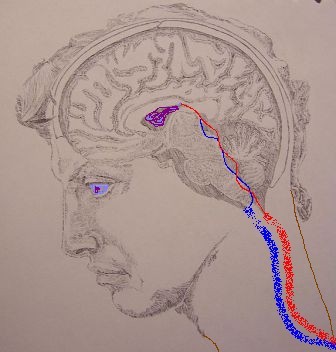
Today, I will go beyond the content of those posts, which contemplated only "the physical Amygdala", to further develop a hypothesis concerning a structure that has been called "the cultural Amygdala" (see Agnotology: The Surge - 2).
The red areas in the graphic above help to depict the two "almond shaped" physical portions of the physical Amygdala in the human brain, while the blue lines attached to it, and winding out from it, are merely additional visual aids for contemplating the concept of the cultural Amygdala (see video below for exact location of the physical amygdala).
In today's post, I will argue that there is a cultural Amygdala, which is a complex web of brain circuits that constitute an "extension" of the physical brain's physical Amygdala.
I use the word "extension", because this hypothetical cultural Amygdala is attached to the physical Amygdala, in the sense that the cultural Amygdala's circuits originate and/or pass through the physical Amygdala, yet extend out into other brain sections as well (e.g. see Hypothesis: The Cultural Amygdala - 3 for connection to the frontal lobe).
I will argue that the cultural Amygdala circuitry is created over a lifetime by the culture one is born and raised in, that is, the beliefs, education, behaviors, and experiences that culture presents to those within it:
We found that amygdala volume correlates with the size and complexity of social networks in adult humans. An exploratory analysis of subcortical structures did not find strong evidence for similar relationships with any other structure, but there were associations between social network variables and cortical thickness in three cortical areas, two of them with amygdala connectivity. These findings indicate that the amygdala is important in social behavior.
(Amygdala Volume and Social Network Size, emphasis added). We begin the basic structure of the hypothesis with the physical Amygdala, set forth in some of the posts linked to above, plus another hint of a cultural Amygdala:
Michael Skinner has just uttered an astounding sentence, but by now he is so used to slaying scientific dogma that his listener has to interrupt and ask if he realizes what he just said. Which was this: “We just published a paper last month confirming epigenetic changes in sperm which are carried forward transgenerationally. This confirms that these changes can become permanently programmed.”
... the life experiences of grandparents and even great-grandparents alter their eggs and sperm so indelibly that the change is passed on to their children, grandchildren, and beyond. It’s called transgenerational epigenetic inheritance: the phenomenon in which something in the environment alters the health not only of the individual exposed to it, but also of that individual’s descendants.
(Sins of the Grandfathers, bold added). That "something in the environment" is the cultural dynamics that every individual is exposed to, yet the "something" varies from group to group (see e.g. Agnotology: The Surge - 3).
According to Skinner, above, some of those impacts of the environment of culture may, in whole or in part, in some cases even be passed on to their progeny.
Over one's lifetime, a cultural Amygdala that is specific to the culture an individual and their descendants are exposed to, is constructed in the brain.
The circuits that comprise the cultural Amygdala have various degrees of permanence, which determines whether they last generations or whether they dissipate in some degree even in one generation.
That is a fundamental difference between the cultural Amygdala and the physical Amygdala, the former is more temporary while the latter is more permanent.
For example, let's hone in on that by recognizing for the moment that a person raised in Mississippi on a small farm, then living there through adulthood, will have a different social awareness and cultural Amygdala when compared to a person who is raised and lives their life in the art district of Paris, France.
The more temporary nature of the cultural Amygdala could be envisioned by imagining that the two individuals, one from Paris and one from Mississippi, were relocated in their teens, the person in Paris relocated to a small farm in Mississippi, and the person in Mississippi relocated to the art district in Paris.
The cultural Amygdala hypothesis would predict, upon relocation, a change over time in the cultural Amydala of both individuals as a result of being placed into very different cultures from the one they experienced through their teen years:
Thought is physical. Learning requires a physical brain change: Receptors for neurotransmitters change at the synapses, which changes neural circuitry. Since thinking is the activation of such circuitry, somewhat different thinking requires a somewhat different brain. Brains change as you use them-even unconsciously. It's as if your car changed as you drove it, say from a stick shift gradually to an automatic.
(The Toxic Bridge To Everywhere, quoting Dr. Lakoff). Nevertheless, the cultural Amygdala hypothesis would also predict that the physical Amygdala, by comparison, would experience little to no change.
An additional example of the more temporary nature of the circuits in the cultural Amygdala is illustrated by the following dynamics:
A group of US marketing researchers claim that brand owners can make their customers believe they had a better experience of a product or service than they really did by bombarding them with positive messages after the event. Advocates of the technique, known as "memory morphing", claim it can be used to improve customers' perceptions of products and encourage them to repeat their purchases and recommend brands to friends.
"When asked, many consumers insist that they rely primarily on their own first-hand experience with products – not advertising – in making purchasing decisions. Yet, clearly, advertising can strongly alter whatconsumers remember about their past, and thus influence their behaviours," he writes in his book, How Customers Think. He says that memories are malleable, changing every time they come to mind, and that brands can use this to their advantage. "What consumers recall about prior product or shopping experiences will differ from their actual experiences if marketers refer to those past experiences in positive ways," he continues.
(Memory Morphing in Advertising, emphasis added; cf. Our Changeable Memory). The hypothetical cultural Amygdala circuitry is malleable to the degree of being subject to relatively weak external input in the form of marketing suggestion and stimuli, which, to the contrary the physical Amygdala would not be.
The following case of an invasion of the physical Amygdala by toxoplasma gondii also engenders the inquiry "which Amygdala is being affected?" by that parasite:
Next, we then saw that Toxo would take the dendrites, the branch and cables that neurons have to connect to each other, and shriveled them up in the amygdala. It was disconnecting circuits. You wind up with fewer cells there. This is a parasite that is unwiring this stuff in the critical part of the brain for fear and anxiety... It knows how to find that particular circuitry... Meanwhile, there is a well-characterized circuit that has to do with sexual attraction. And as it happens, part of this circuit courses through the amygdala, which is pretty interesting in and of itself, and then goes to different areas of the brain than the fear pathways... Toxo knows how to hijack the sexual reward pathway.
...
On a certain level, this is a protozoan parasite that knows more about the neurobiology of anxiety and fear than 25,000 neuroscientists standing on each other's shoulders... But no doubt it's also a tip of the iceberg of God knows what other parasitic stuff is going on out there. Even in the larger sense, God knows what other unseen realms of biology make our behavior far less autonomous than lots of folks would like to think.
(A Talk With Dr. Sapolsky, emphasis added). The argument can be made that the parasitic invasion affects both Amygdalas (physical & cultural), or either one individually, depending on the severity and target of the invasion by those toxoplasma parasites (but the obvious default primary suspect is the physical Amygdala).
Either way, the cases above support the hypothesis that we have a malleable cultural Amygdala, and in some cases a malleable physical Amygdala, even though the latter is not as malleable in any significant degree.
This hypothetical cultural Amygdala is also "weaker" than the physical Amygdala, if the following case is instructive:
... [Whitman] killed a receptionist with the butt of his rifle. Two families of tourists came up the stairwell; he shot at them at point-blank range. Then he began to fire indiscriminately from the deck at people below. The first woman he shot was pregnant. As her boyfriend knelt to help her, Whitman shot him as well. He shot pedestrians in the street and an ambulance driver who came to rescue them.
The evening before, Whitman had sat at his typewriter and composed a suicide note:
I don’t really understand myself these days. I am supposed to be an average reasonable and intelligent young man. However, lately (I can’t recall when it started) I have been a victim of many unusual and irrational thoughts.
By the time the police shot him dead, Whitman had killed 13 people and wounded 32 more. The story of his rampage dominated national headlines the next day. And when police went to investigate his home for clues, the story became even stranger: in the early hours of the morning on the day of the shooting, he had murdered his mother and stabbed his wife to death in her sleep.
It was after much thought that I decided to kill my wife, Kathy, tonight … I love her dearly, and she has been as fine a wife to me as any man could ever hope to have. I cannot rationa[l]ly pinpoint any specific reason for doing this …
Along with the shock of the murders lay another, more hidden, surprise: the juxtaposition of his aberrant actions with his unremarkable personal life. Whitman was an Eagle Scout and a former marine, studied architectural engineering at the University of Texas, and briefly worked as a bank teller and volunteered as a scoutmaster for Austin’s Boy Scout Troop 5. As a child, he’d scored 138 on the Stanford-Binet IQ test, placing in the 99th percentile. So after his shooting spree from the University of Texas Tower, everyone wanted answers.
For that matter, so did Whitman. He requested in his suicide note that an autopsy be performed to determine if something had changed in his brain — because he suspected it had.
I talked with a Doctor once for about two hours and tried to convey to him my fears that I felt [overcome by] overwhelming violent impulses. After one session I never saw the Doctor again, and since then I have been fighting my mental turmoil alone, and seemingly to no avail.
Whitman’s body was taken to the morgue, his skull was put under the bone saw, and the medical examiner lifted the brain from its vault. He discovered that Whitman’s brain harbored a tumor the diameter of a nickel. This tumor, called a glioblastoma, had blossomed from beneath a structure called the thalamus, impinged on the hypothalamus, and compressed a third region called the amygdala.
(Atlantic Monthly, it was 'moved', so Wayback Machine version). The compression of the physical Amygdala could impair or alter input from the eyes, ears, nose, taste buds, and touch because all those data-flows go directly to the physical Amygdala first (see video below).
In the Whitman case that tumor likely caused the physical Amygdala to malfunction, override the cultural Amygdala, and thereby impair the self-awareness Whitman had of himself.
Whitman's statement "I don't really understand myself these days" is indicative of his well developed self-awareness, in terms of thinking patterns and emotional composition, and that he was detecting ongoing changes within himself that were not normal to him (which may link the cultural Amygdala to self awareness -- see e.g. Self-Awareness Require Complex Brain?).
Some of the functions of the cultural Amygdala as well as the physical Amygdala could be implicated by those changes.
Whitman perceived a malfunction but was not able to get any useful handle on it, even with the help of mental health professionals.
This post is getting a bit long, so, more to come in future posts of this series (including the relation of the cultural Amygdala to the toxins of power).
There may be a perceived contradiction among the various hypotheses Toxins of Power Blog talks about concerning the origin of the toxins of power.
So, before proceeding let's clear the air of some of the fog that perception might generate.
First, let's note again for the record that Toxins of Power Blog has posted from the inception of these series the assertion that behavior can lead to conditions for the generation of toxins of power.
However, equally important is the repeated assertion that behavior can also control or neutralize those toxins by generating anti-toxins.
So let's reflect on quotes from earlier posts to firm up that aspect, noting the notion of anti-toxins:
This formula shows that the exercise of any official is to resist corrupting toxins via antitoxins. The goal is to bring "T" and "A" to the same value, so that T - A sums to zero.
...
Finally, we need to ask what [behaviors], then, are toxins and what are their numeric values, and what [behaviors] are antitoxins and what are their numeric values.
(Tables For The Toxins In Power). Fundamentally the hypothesis provides tables which indicate that some behaviors are toxic so those behaviors are likely to increase the presence of toxins of power, but to the contrary other behaviors are anti-toxic and are therefore likely to decrease the presence of toxins of power.
Moving on to the meme aspect of the hypothesis, this would mean that memetic morph is unlikely to take place if certain anti-toxic behaviors are practiced:
In the first post of this series we talked about memetic morph whereby a meme changes through some corruption of memory.
Some of the morph that takes place in such a case has been described in our series as a partial corruption of the strands of memes within an individual's memory.
One allegorical or symbolic example can be demonstrated by comparing what happens when there is a phenomenon that appears as an "innocent corruption of memory" described by Dr. Roger A. Pielke Sr. engendered by the inaccurate reading of text.
Even this can lead to memetic morphs that generate corrupt memes then their propagation throughout a meme complex, and even beyond that.
(A Structure RE: Corruption of Memes - 2). Moving on to the hypothesis that microbes are the source for the origin of toxins of power, this indicates that certain behaviors increase the likelihood of microbial generation of toxins, but other behaviors decrease that likelihood.
We have support for that, in principle, from another post:
"the genetic argument allows us the luxury of ignoring past and present historical and social factors. In the words of Louis Menand who wrote in the New Yorker very astutely:
“It’s all in the genes”: an explanation for the way things are that does not threaten the way things are. Why should someone feel unhappy or engage in antisocial behavior when that person is living in the freest and most prosperous nation on Earth? It can’t be the system! There must be a flaw in the wiring somewhere.”
... which is a good way to put it. So the genetic argument is simply a cop-out that allows us to ignore the social and economic and political factors that in fact underlie many troublesome behaviors" (Dr. Maté).
(The "It's In Your Genes" Myth). The bottom line of these hypotheses is that behavior is a functional aspect of both toxin increase as well as toxin decrease, depending on the type of behavior.
It is important to note that this is not in conflict with the research, but to the contrary it is supported by the research.